Debt Payoff Calculator: Build a Payoff Plan That Actually Works
Table of Contents
- 1. What a Debt Payoff Calculator Actually Computes
- 2. The Two Numbers: APR and Minimums
- 3. Extra Payments: Where the Real Savings Hide
- 4. One Debt or Many? Snowball vs Avalanche
- 5. Worked Example: Three Debts, One Plan
- 6. How to Use the Toolenix Debt Payoff Calculator
- 7. Mistakes That Quietly Add Years
- 8. Beyond Credit Cards: Student Loans, Excel, and More
Here is a number most people never calculate: what their debt actually costs if they pay only the minimums. On a $5,000 credit card balance at 22% APR with a $125 minimum payment, the answer is about $4,100 in interest over more than six years — nearly doubling the price of whatever was bought. That single figure is why a debt payoff calculator exists: it converts three boring inputs (balance, APR, minimum payment) into the two numbers that matter (your debt-free date and your total interest), and then lets you test what happens when you change the plan.
This guide walks through how these calculators work, what the inputs really mean, how extra payments and the snowball and avalanche methods change the math, and how to build a complete payoff plan — including a worked example with real numbers run through the free Toolenix debt payoff calculator.
What a Debt Payoff Calculator Actually Computes
At its core, a debt payoff calculator is an amortization simulator. You give it the current balance, the annual percentage rate (APR), and the minimum monthly payment, and it steps forward month by month: each month it adds one month of interest to the balance, subtracts your payment, and repeats until the balance hits zero. The outputs are your payoff date, the number of months it takes, the total amount you will pay, and — the eye-opener — the total interest.
The best debt payoff calculator tools go further. A credit card debt payoff calculator should let you add an extra monthly payment and show the difference side by side: months saved and interest saved. A debt payoff calculator with multiple accounts should accept several balances at different APRs and simulate a payoff order — smallest balance first (snowball) or highest rate first (avalanche) — rolling each cleared payment into the next target. And a debt payoff calculator with extra payments should make one thing visceral: how a modest extra amount, applied consistently, collapses both the timeline and the interest.

The Two Numbers That Drive Everything: APR and Minimums
Two inputs dominate every result the calculator produces. The first is the APR. Credit card APRs in the US commonly sit between 20% and 30%, which means a $5,000 balance accrues roughly $85–$125 in interest every single month before you pay a cent toward the principal. The second is the minimum payment, which is usually set around 1–2% of the balance plus interest — deliberately calibrated to keep you paying for years. Minimums are not a plan; they are the lender's preferred schedule.
This is also why accuracy questions come up. A calculator assumes your APR stays fixed, you make every payment on time, and you add no new charges. In real life, penalty APRs, late fees, and new spending move the goalposts. Treat the calculator's output as the payoff date for the plan you commit to — not a prophecy. The Federal Reserve's G.19 release tracks aggregate US consumer credit and shows just how much revolving balances cost households in aggregate; your personal version of that number is what the calculator reveals.
Extra Payments: Where the Real Savings Hide
Nothing changes a payoff plan like an extra payment, because every extra dollar goes straight to principal — and principal you kill today never accrues interest tomorrow. Take that $5,000 balance at 22% APR with a $125 minimum. Paying only the minimum takes about 73 months and costs roughly $4,100 in interest. Add just $100 extra per month and the picture transforms: about 29 months, roughly $1,480 in interest. That is $2,600 saved and 44 months — nearly four years — erased, from an extra $100 a month.
The effect compounds because of how amortization works: early in the schedule, most of your payment is interest; as the balance falls, more of each payment attacks principal, and extra payments accelerate that crossover. This is the single most useful thing to test in any debt payoff calculator: nudge the extra payment up by $25 or $50 at a time and watch the total interest fall. Small, sustainable extras beat heroic, short-lived ones — a plan you abandon in month three saves nothing.
One Debt or Many? Running Snowball and Avalanche Side by Side
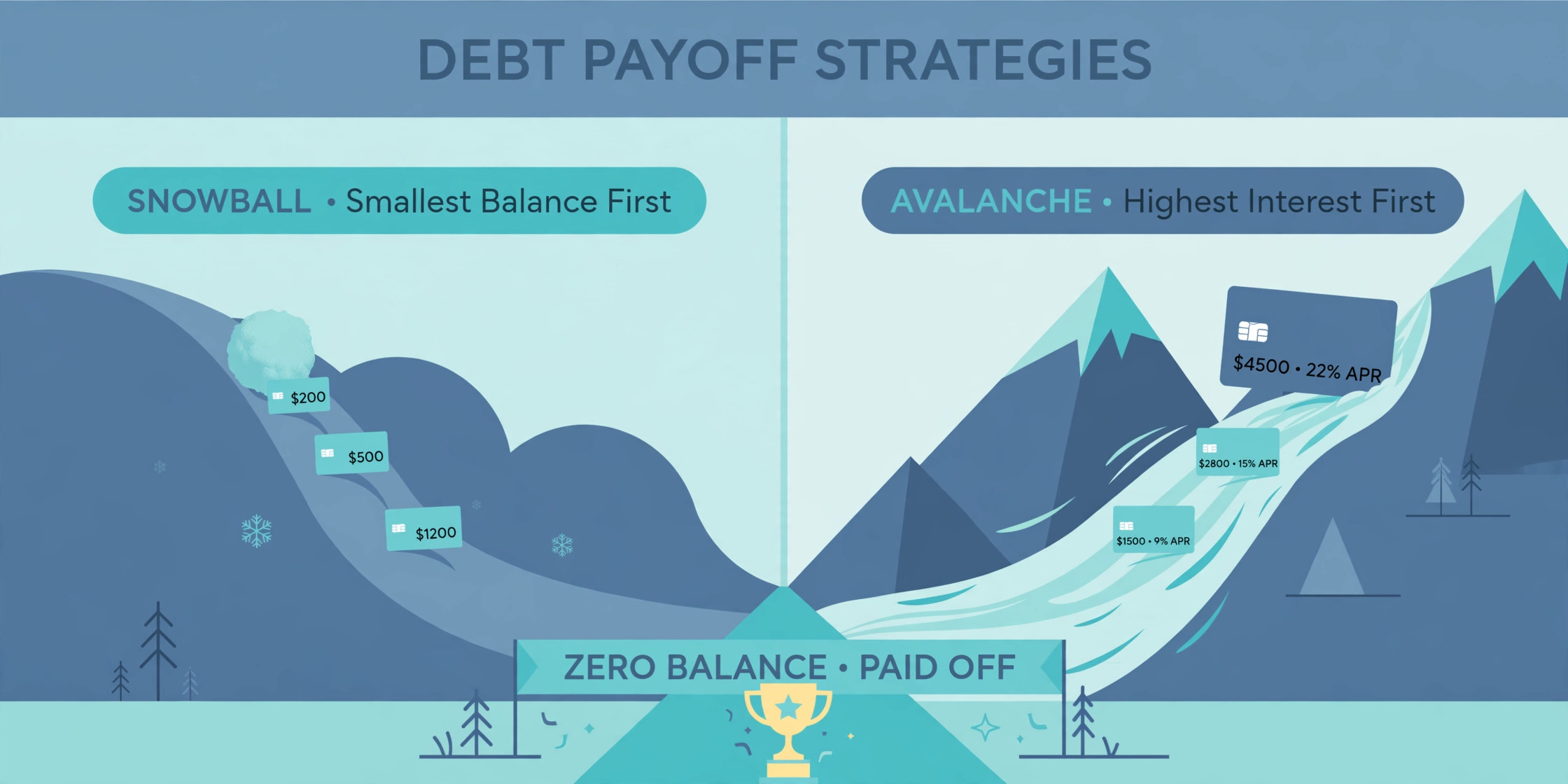
With a single balance, the only decision is how much extra to pay. With several, you also choose the order — and that is where the two famous strategies enter. The debt snowball method (popularized by Dave Ramsey — hence the many searches for a dave ramsey debt payoff calculator) attacks the smallest balance first for quick wins and momentum. The debt avalanche method attacks the highest APR first, which minimizes total interest mathematically.
A debt snowball calculator and a debt avalanche calculator are really the same engine with a different sort order, and the honest answer is that both beat having no order at all. The avalanche always wins on interest; the snowball often wins on follow-through, because clearing a whole balance early is motivating. If you want the full debate with a worked comparison, read our companion guide on debt snowball vs avalanche — what follows here is how to run both strategies through a calculator and compare the actual numbers for your debts.
Worked Example: Three Debts, One Plan
Let us run a realistic multi-debt scenario through the calculator. Three balances, three APRs:
- Store card: $4,500 at 24.99% APR, $115 minimum
- Credit card: $2,800 at 17.99% APR, $70 minimum
- Personal loan: $9,200 at 9.49% APR, $195 minimum
Minimums total $380 a month. Paying only minimums, the calculator shows roughly 82 months — nearly 7 years — and about $8,780 in interest. Now add $250 a month in extra payments, aimed at one target at a time while minimums cover the rest:
- Avalanche + $250: about 38 months, roughly $3,240 in interest
- Snowball + $250: about 38 months, roughly $3,550 in interest
Both strategies finish in the same month here, but the avalanche saves about $310 in interest — free money for choosing the higher-rate target first. And compared with minimums-only, either plan saves more than $5,200 and nearly four years. Even a smaller extra — $100 a month on the avalanche — finishes in about 53 months at roughly $4,890 interest. The lesson is consistent: the size of the extra payment matters more than the method, but the method still matters.
How to Use the Toolenix Debt Payoff Calculator
The Toolenix debt payoff calculator — free, no sign-up — runs entirely in your browser — balances and APRs never leave your device, which matters when you are typing real financial numbers into a web page. It has two modes. Single-debt mode takes one balance, APR, and minimum payment, plus an optional extra monthly amount, and returns the payoff timeline with a balance-over-time chart. Multi-debt mode is the differentiator most free calculators lack: enter up to several debts with their own balances, APRs, and minimums, set one extra monthly payment, and choose snowball or avalanche. The tool then runs a true month-by-month simulation — minimums on every account, the extra payment aimed at the current target, freed-up payments rolling into the next target — and shows the payoff order, the month each debt clears, and the totals for each strategy so you can compare them directly.
A practical workflow: enter your real numbers, run the avalanche, note the total interest and payoff date; switch to snowball and compare. If the avalanche saves meaningful money at a similar finish date, take it. If the snowball clears your first debt dramatically sooner and you know you need the win, take that — the best plan is the one you will actually follow for 38 months.
Mistakes That Quietly Add Years
Keep spending on the card you are paying off. New charges reset the progress the calculator assumed was permanent. If willpower is the issue, stop using the target card entirely while the plan runs.
Ignoring fees and rate changes. Late fees, annual fees, and penalty APRs are not in the basic inputs. If any apply, add the fee amounts to the balance you enter so the simulation stays honest.
Setting the extra payment too high. A $400 extra that collapses after two months loses to a $150 extra sustained for three years. Build the plan around the amount you can pay in your worst month, not your best.
Never re-running the numbers. Balances, APRs, and budgets change. Re-run the calculator every few months — or after any windfall — and redirect the new extra at the current target. A payoff plan is a living document, not a one-time printout.
Beyond Credit Cards: Student Loans, Excel, and Other Flavors
The same math governs every amortizing debt, which is why you will find specialized variants everywhere: a student loan debt payoff calculator for education debt (often with graduated or income-driven payment options layered on), car loan and mortgage payoff tools, and the venerable debt payoff calculator Excel templates for spreadsheet loyalists who want full control of the formulas. Spreadsheets are powerful but unforgiving — one broken cell reference and the whole plan is fiction. An online calculator trades that flexibility for guardrails: validated inputs, instant recalculation, and a month-by-month schedule you can sanity-check at a glance.
Whichever flavor you use, the discipline is identical: list every debt with its real APR, commit to minimums on all of them, aim every spare dollar at one target, and re-run the plan when life changes it. The calculator does the arithmetic; you supply the consistency.
Try it free — no sign-up
Run the numbers yourself in seconds with this free debt payoff calculator. Everything happens in your browser.
Open the Debt Payoff CalculatorFrequently Asked Questions
How do I use a debt payoff calculator?
Enter each debt's current balance, its APR, and the minimum monthly payment. Add the extra amount you can pay each month, then choose a payoff order — smallest balance first (snowball) or highest rate first (avalanche) if you have multiple debts. The calculator simulates the schedule month by month and returns your debt-free date, total interest, and (in multi-debt mode) the order each account clears. Re-run it whenever a balance, rate, or your budget changes.
How accurate are debt payoff calculators?
They are exact for the inputs you give them, but real life moves the inputs: APRs change, fees appear, and new charges get added. A calculator assumes fixed rates, on-time payments, and no new spending. Treat its payoff date as the result of the plan you commit to — the closer your behavior matches the inputs, the closer reality matches the output. Adding known fees into the balance you enter keeps the simulation honest.
How do I create a debt payoff plan?
List every debt with its balance, APR, and minimum payment. Pay minimums on all of them, then aim every spare dollar at a single target — smallest balance first for momentum (snowball) or highest APR first for minimum interest (avalanche). Run both orders through a calculator, pick the plan you will actually sustain, automate the payments, stop adding new charges to target accounts, and re-check the plan every few months.
Can a debt payoff calculator handle multiple accounts at once?
A good one can. Multi-debt mode accepts several balances with different APRs and minimums, takes one extra monthly payment, and simulates the payoff order month by month — minimums everywhere, the extra aimed at the current target, freed payments rolling into the next. The Toolenix debt payoff calculator does exactly this for both snowball and avalanche, so you can compare total interest and payoff dates side by side.
Should I choose the snowball or the avalanche method?
The avalanche always costs less in interest; the snowball usually feels better because it clears an entire balance sooner. In practice, run both in the calculator: if the avalanche saves meaningful money at a similar finish date, take it. If the snowball clears your first debt dramatically earlier and you need that motivation, take the snowball. Either plan, followed consistently, beats minimums-only by years.