Unit Converter Guide: Metric to Imperial Conversions Explained
Table of Contents
"How many feet is 2 meters?" "What's 350'F in Celsius?" "Is 5'9" tall in centimeters?" If you've ever typed one of these into a search box, you've used a unit converter — probably without thinking about what's happening under the hood. And that's the point: unit conversion should be instant and invisible, a tiny piece of arithmetic that gets out of your way so you can get back to the recipe, the road trip, or the workout plan.
But there's more going on than multiply-by-a-number. Temperature needs an offset, not just a scale factor. Gallons come in two different sizes depending on which side of the Atlantic you're on. And data storage units quietly switched definitions halfway through computing history. This guide covers what a unit converter actually does, the metric-to-imperial divide that creates most of the work, the nine conversion categories worth knowing, the formulas that matter, and the traps that catch everyone at least once.
What a Unit Converter Actually Does
At its core, a unit converter translates a measurement from one unit to another within the same physical quantity. Miles to kilometers (length to length), pounds to kilograms (weight to weight), hours to minutes (time to time). It cannot convert across quantities — no honest tool will turn 5 liters into kilograms, because volume and mass are different things (though density connects them, which is exactly why cooking converters sometimes cheat).
For most categories the math is a single multiplication: value × conversion factor = result. One inch is defined as exactly 2.54 centimeters, so 10 inches is 10 × 2.54 = 25.4 cm. The factor never changes, which is why a unit conversion calculator is deterministic — the same input always gives the same output, to as many decimal places as you want.
Temperature is the famous exception. Converting between Celsius and Fahrenheit isn't just scaling; the two scales start at different zeros, so you need an offset too: °F = °C × 9/5 + 32. Forget the +32 and your "converted" oven temperature will be off by enough to ruin dinner. A good temperature unit converter handles this automatically, which is one more reason to use a proper tool instead of mental math when precision matters.
An online unit converter wraps all of this in a simple interface: pick the category, enter the number, choose the source and target units, read the answer. The best ones — like a free unit converter that runs entirely in your browser — do the arithmetic locally, instantly, with no sign-up and no data leaving your device.
Metric vs Imperial: The Two Systems You Keep Converting Between
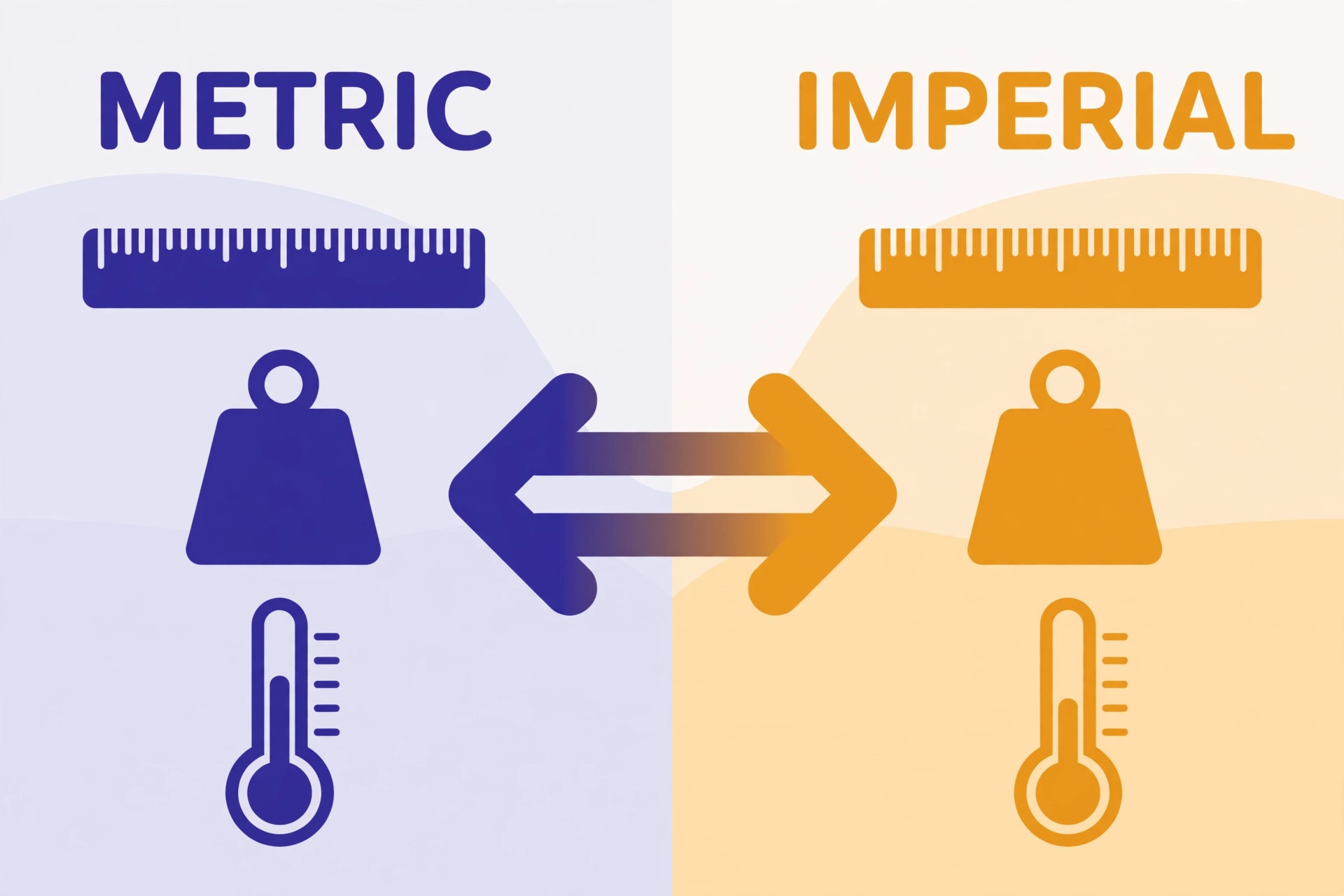
Roughly 95% of unit converter searches are really asking one question: how do I get from metric to imperial, or imperial to metric? The metric system (SI) is decimal and universal — meters, grams, liters, built on powers of ten. The imperial system (and its close cousin, US customary) is historical — inches, pounds, gallons, built on body parts, trade customs, and royal decrees.
Here's the practical divide. Science, medicine, engineering, and nearly every country on Earth use metric. Everyday life in the United States — plus a stubborn holdout mix in the UK and Canada — uses imperial. So the conversions that matter most are the bridges between the two worlds:
Length: 1 inch = 2.54 cm (exact, by international agreement since 1959) · 1 foot = 30.48 cm · 1 mile = 1.60934 km. Going imperial to metric, multiply; going metric to imperial, divide — or just let the converter handle the direction.
Weight: 1 pound = 0.453592 kg · 1 ounce = 28.3495 g · 1 stone (UK) = 6.35029 kg. Note that the ounce pulls double duty: there's a weight ounce and a fluid ounce for volume, and they are not the same thing. More on that trap below.
Temperature: the offset problem described above. 0°C = 32°F (freezing), 100°C = 212°F (boiling), and human body temperature sits at 37°C = 98.6°F.
Volume: 1 US gallon = 3.78541 liters, but 1 imperial gallon = 4.54609 liters — a 20% difference that has ruined many a recipe and fuel-economy comparison.
A metric to imperial converter earns its keep precisely because these factors are awkward, non-round numbers you'll never memorize reliably. Nobody remembers 1.60934; everybody remembers "about 1.6" — and "about" is fine for a road trip estimate but not for a medication dose.
The 9 Conversion Categories, Explained
A complete converter covers more than length and weight. Here are the nine categories a serious tool handles, and when each one actually comes up in real life:
Length unit converter. Millimeters to miles and everything between. Used for DIY projects, sewing, screen sizes, running distances, and real estate. The workhorse category — probably half of all conversions ever performed.
Weight unit converter. Grams to pounds, ounces to kilograms. Cooking (especially baking, where precision matters), shipping, luggage limits, gym progress, and baby weights.
Temperature unit converter. Celsius, Fahrenheit, Kelvin. Weather, cooking, fevers, science homework, and thermostat wars. The only category that needs addition as well as multiplication.
Area. Square feet to square meters, acres to hectares. Flooring, land, apartment hunting across countries — anyone who's compared a 900 sq ft flat to an 85 m² one has done this conversion.
Volume. Cups to milliliters, gallons to liters, fluid ounces. Recipes are the #1 use case, followed by fuel, aquariums, and engine displacements.
Speed. mph to km/h, knots to m/s. Driving abroad, cycling stats, wind speeds in weather reports, and internet-adjacent "how fast" questions.
Time unit converter. Seconds to hours, days to weeks, and the odd ones like fortnights. Project planning, billing hours, cooking times, and converting between time zones' worth of scheduling math.
Data storage. Bytes to gigabytes, with the eternal 1000-vs-1024 asterisk (see mistakes, below). Buying drives, understanding "why is my 1 TB drive only 931 GB," and data plan math.
Pressure unit converter. PSI to bar, atmospheres to pascals. Tire pressure, scuba diving, weather maps, and espresso machines — a niche category, but when you need it, you really need it.
A unit converter chart taped to the fridge covers one category; an online tool covering all nine replaces the whole drawer of charts.
Worked Examples: The Formulas Worth Knowing
You don't need to memorize every factor — that's what the converter is for — but knowing the shape of the math helps you sanity-check results. Here are the conversions people look up most, worked through:
Miles to kilometers. 26.2 miles (a marathon) × 1.60934 = 42.16 km. The reverse: 100 km ÷ 1.60934 = 62.14 miles. Quick estimate: multiply miles by 1.6, or think "a kilometer is about 62% of a mile."
Pounds to kilograms. 180 lb × 0.453592 = 81.65 kg. Reverse: 70 kg ÷ 0.453592 = 154.3 lb. Gym shortcut: divide pounds by 2.2 — close enough for plate math.
Fahrenheit to Celsius. 350°F (a common baking temperature) → (350 − 32) × 5/9 = 176.7°C, usually rounded to 180°C in recipes. And 72°F room temperature → (72 − 32) × 5/9 = 22.2°C.
Inches to centimeters. A 55-inch TV: 55 × 2.54 = 139.7 cm diagonal. Screen sizes are always diagonal, in both systems — a rare moment of international agreement.
Gallons to liters. A 15-gallon (US) fuel tank × 3.78541 = 56.78 liters. If you're comparing US mpg figures to European L/100km figures, convert both the distance and the volume — this is a two-axis conversion and a single-factor guess will mislead you.
The pattern: pick the right category first, then apply the factor. When a result looks wrong — a human height converting to 0.18 meters, say — you almost certainly picked the wrong source unit (millimeters instead of centimeters), not the wrong math.
The Mistakes Everyone Makes
The temperature offset. The single most common conversion error in the world: multiplying Celsius by 9/5 and forgetting the +32. 20°C isn't 36°F (that's below freezing); it's 68°F. If your converted temperature would kill a houseplant or freeze a pipe unexpectedly, check the offset.
Ounces: weight vs fluid. A "16 oz" steak and "16 fl oz" of water are different measurements that happen to share a name. The weight ounce (28.35 g) and the fluid ounce (29.57 ml) are close enough to confuse and different enough to matter in baking and chemistry.
US vs imperial gallons (and pints, and tons). The US gallon is 3.79 liters; the imperial gallon is 4.55 liters. A "ton" can be 2,000 lb (US short ton), 2,240 lb (imperial long ton), or 1,000 kg (metric tonne). Always check which country's unit you're converting from.
The kilobyte confusion. Storage manufacturers count in decimal (1 GB = 1,000,000,000 bytes) while operating systems historically counted in binary (1 GiB = 1,073,741,824 bytes). That's why a "1 TB" drive shows as 931 GB — nothing is missing; you're just reading two different definitions of the prefix.
Precision theater. Converting 5 miles gives 8.04672 km, but if your input was a rounded estimate, those extra decimals are fiction. Match your output precision to your input precision — a converter that shows ten decimals isn't more accurate, it's just more verbose.
How to Use an Online Unit Converter
Using a unit converter app in your browser takes about five seconds: select the category (length, weight, temperature, and the rest), type your number, choose the "from" unit, choose the "to" unit, and read the result. The whole interaction is one form — there's nothing to install and no account to create.
A few habits make it foolproof. First, confirm the category before the units — most wrong answers come from converting in the wrong category (volume ounces vs weight ounces) rather than from bad arithmetic. Second, glance at the magnitude: if 6 feet converts to 1.83 meters you're fine; if it says 18.3, you picked the wrong source unit. Third, for temperature, never trust a result you computed by scaling alone — the offset is doing half the work, and it's the half everyone forgets.
The Toolenix Unit Converter Online covers all nine categories — length, weight, temperature, area, volume, speed, time, data storage, and pressure — with metric-to-imperial and imperial-to-metric directions, instant results as you type, and everything computed locally in your browser. No sign-up, no uploads, no watermarks: the conversion happens on your device, which also means it works the same on a phone in a grocery store as on a desktop at work.
Try it free — no sign-up
Run the numbers yourself in seconds. Everything happens in your browser.
Open the Unit Converter OnlineFrequently Asked Questions
What is a unit converter?
A unit converter is a tool that translates a measurement from one unit to another within the same category — for example, miles to kilometers, pounds to kilograms, or Fahrenheit to Celsius. An online unit converter does this instantly: you enter a value, pick the source and target units, and it applies the exact conversion factor. Good converters cover many categories (length, weight, temperature, time, pressure, area, volume, speed, and data), handle the tricky non-linear cases like temperature correctly, and show enough decimal precision for the job at hand.
How do I convert metric to imperial and back?
Use a metric to imperial converter and pick the right factor for the category. The everyday ones: 1 inch = 2.54 cm, 1 mile = 1.60934 km, 1 pound = 0.453592 kg, 1 gallon (US) = 3.78541 liters. For imperial to metric, divide instead of multiply — or just enter the value and let the converter handle the direction. Temperature is the exception: it needs an offset as well as a scale factor (°F = °C × 9/5 + 32), so don’t try to eyeball it.
How do you convert Fahrenheit to Celsius quickly?
The exact formula is (°F − 32) × 5/9 = °C. For a mental estimate, subtract 30 and halve the result — 80°F becomes roughly 25°C (exact: 26.7°C). Going the other way, double the Celsius value and add 30: 25°C ≈ 80°F (exact: 77°F). These estimates are fine for weather and cooking; use a temperature unit converter for anything where precision matters, like medication or engineering.
Why does the US still use the imperial system?
Mostly inertia. The US signed the Meter Convention in 1875 and metric is technically the preferred system for trade and science, but everyday life — road signs, cooking, construction, body weight — stayed imperial because there was never a coordinated national switch like the ones in the UK, Canada, or Australia. The result is a dual-system world: American engineers work in metric, American kitchens work in cups and Fahrenheit, and everyone converting between the two needs a reliable unit conversion calculator.
Is there a free unit converter app I can use without installing anything?
Yes — a web-based unit converter works like a unit converter app but runs entirely in your browser, with nothing to install and no account needed. Toolenix’s free unit converter covers 9 categories (length, weight, temperature, area, volume, speed, time, data storage, and pressure), works on phones, tablets, and desktops, and processes everything locally so your conversions stay private.
How do I use an online unit converter?
Pick the category (for example, a length unit converter for miles-to-kilometers), enter your number, select the ‘from’ and ‘to’ units, and read the result. Three tips: double-check you’ve picked the right category (fluid ounces for volume vs. ounces for weight trip people up constantly), watch for US vs. imperial gallons (they differ by about 20%), and remember temperature conversions need the offset — which is exactly why using a proper converter beats mental math.