How Compound Interest Builds Millionaires (With Numbers)
Table of Contents
Two friends, same salary, same $500 monthly investment, same 7% average annual return. One starts at 25. The other waits until 35 — "I'll start when I'm earning more," he says, and he does earn more, eventually investing $750 a month to catch up.
At 65, the early starter has about $1.2 million. The late starter, despite contributing more per month for 30 years, has about $613,000. The ten-year head start was worth more than doubling the monthly contribution.
That gap — roughly $600,000 — is the price of waiting. Not the price of picking wrong stocks, not the price of high fees. Just waiting. Compound interest is the only force in personal finance where time matters more than money, and most people learn that a decade too late.
What compounding actually does (no magic, just math)
Compound interest means your returns earn their own returns. In year one, $6,000 invested at 7% earns $420. In year two, you earn 7% on $6,420 — $449. The extra $29 looks trivial. By year 30, that snowballing effect means your money is earning more each year than you contribute.
Here's the shape of it with $500/month at 7%, compounded monthly:
- After 10 years: ~$86,000 (you put in $60,000; growth added $26,000)
- After 20 years: ~$262,000 (you put in $120,000; growth added $142,000)
- After 30 years: ~$613,000 (you put in $180,000; growth added $433,000)
- After 40 years: ~$1,200,000 (you put in $240,000; growth added $960,000)
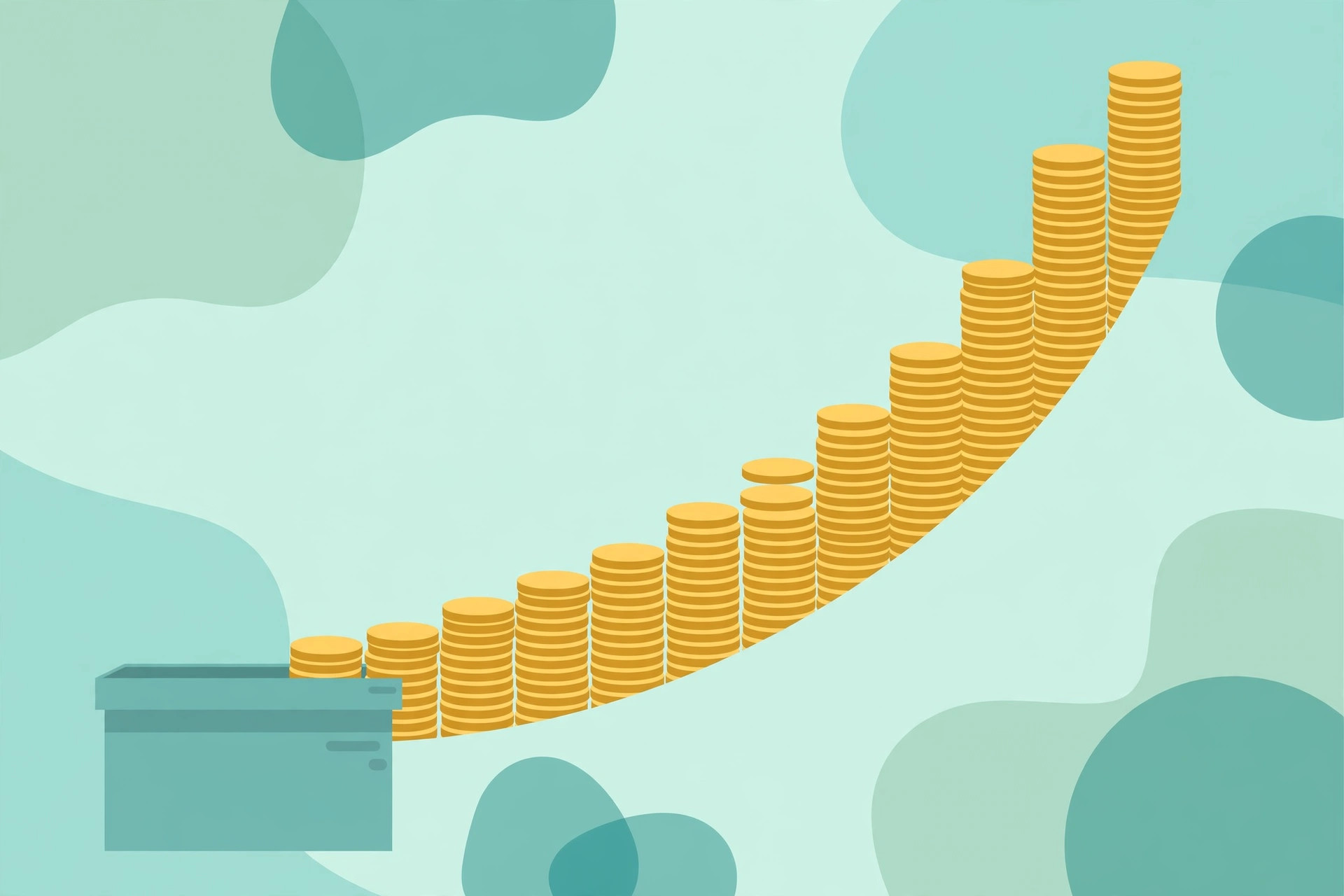
Look at the last line: of the $1.2 million, you contributed $240,000 and compounding contributed $960,000. Four-fifths of the final balance is growth-on-growth. And notice the curve — the jump from year 30 to year 40 ($587,000) is bigger than everything accumulated in the first 20 years combined. Compounding is back-loaded. The early years feel pointless; the later years feel miraculous. Both feelings are the same math.
This is why "start early" isn't motivational-poster fluff. Every year you delay doesn't just cost you that year's contribution — it costs you that contribution's 30 or 40 years of compounding, which is where most of the money comes from.
The brutal cost of waiting: three scenarios
Let's make it concrete with three savers, all earning 7% average annual returns, all retiring at 65.
Maya starts at 25: $500/month for 40 years. Total contributed: $240,000. Final balance: ~$1,200,000.
Dev starts at 35: $500/month for 30 years. Total contributed: $180,000. Final balance: ~$613,000. He contributed $60,000 less but ended up ~$587,000 poorer. The missing decade cost him nearly ten times what he "saved" by not investing.
Priya starts at 35 but invests $1,000/month — double Maya's amount — for 30 years. Total contributed: $360,000. Final balance: ~$1,226,000. She barely catches Maya, despite contributing $120,000 more of her own money. Doubling your contribution for 30 years roughly equals starting 10 years earlier at half the amount. Time is that powerful.
And the flip side: Sam starts at 25, invests $500/month for just 10 years, then stops completely — never adds another dollar. Total contributed: $60,000. That $86,000 balance at 35 keeps compounding for 30 more years untouched: ~$700,000 at 65. Sam contributed $60,000 total and beat Dev, who contributed $180,000. Let that sink in.
The lesson isn't "invest a lot." It's "invest early, then let time do the heavy lifting."
The 7% assumption: honest expectations
Every number above assumes 7% average annual returns. Where does that come from? The US stock market (S&P 500) has returned roughly 10% per year before inflation over the long run, about 7% after inflation. Using 7% is the standard planning assumption for a stock-heavy portfolio in today's dollars.
But "average" hides the ride. In any given decade, returns might be 15% or 2%. The 7% shows up as an average across 30–40 years, not as a yearly promise. Someone who started investing in 2000 watched a decade of essentially zero net gains before the compounding resumed. The math still worked — it just required the one thing investors hate: patience through ugly years.
Fees eat this math quietly. A 1% annual fee (typical for actively managed funds or some advisors) on a 7% return leaves you 6% — and over 40 years, that single percentage point costs roughly 25–30% of your final balance. On Maya's $1.2 million, that's $300,000+ vaporized by fees. Low-cost index funds charging 0.03–0.20% exist precisely to keep that money yours. This is the rare case where being cheap is the sophisticated move.
Inflation deserves a mention too. That $1.2 million at 65 will have the purchasing power of roughly $500,000–$600,000 in today's dollars (assuming ~2.5% inflation). Still life-changing money from $500/month — but plan in real terms so the headline number doesn't mislead you.
"But I can't invest $500 a month"
Fair. Most 25-year-olds can't. So let's run what they can do, because the math of small amounts surprises people too.
$100/month from 25 to 65 at 7%: ~$240,000. From $48,000 of contributions. That's a quarter-million dollars from the cost of a few takeout meals a week.
$200/month: ~$480,000. The pattern is linear with contributions — double the monthly amount, double the outcome — but exponential with time.
And the "I'll start when I earn more" crowd should hear this: starting with $100/month at 25 and increasing contributions as income grows beats starting with $500/month at 35. A saver who invests $100/month at 25, bumps to $300 at 30, and $500 at 35 ends up ahead of the pure $500-from-35 saver, while contributing less overall in the early years. The early dollars do disproportionate work.
Employer 401(k) matches are free acceleration. If your employer matches 50% up to 6% of salary, that's an instant 50% return on matched contributions before compounding even starts. Turning down the full match is the only investing mistake worse than starting late. Contribute enough to capture every matched dollar before you invest anywhere else.
Your move this week
Compound interest rewards one behavior above all: starting, even small, even imperfectly. Here's the concrete version:
First, open the account if you don't have one — a Roth IRA if you're eligible (contributions are after-tax, growth is tax-free), or bump your 401(k) contribution by 1%. The account type matters less than the existence of automatic monthly transfers.
Second, automate the transfer for the day after payday. Money you never see doesn't get spent. Start with whatever doesn't hurt — $50, $100 — and schedule a 1% annual increase. You'll never feel it; your future balance will.
Third, put it in a low-cost total-market index fund and stop checking it. Checking quarterly is plenty. The investors who build million-dollar balances aren't the ones with brilliant timing — they're the ones who set up automatic contributions in their twenties and then got bored and left it alone for decades.
Boredom is the strategy. The math does the rest.
Test your own timeline with the Compound Interest & Investment ROI Calculator — plug in your monthly amount, your age, and 7%, then move the start date ten years later and watch what happens to the final number. It's the most motivating 30 seconds in personal finance.
Try it free — no sign-up
Run the numbers yourself in seconds. Everything happens in your browser.
Open the Compound Interest & Investment ROI CalculatorFrequently Asked Questions
How much do I need to invest monthly to become a millionaire?
About $500/month from age 25 to 65 at a 7% average annual return gets you to roughly $1.2 million. Starting at 35, you'd need about $1,000/month to reach the same target. Starting at 45, roughly $2,100/month. Every decade of delay roughly doubles the required monthly amount.
What is a realistic rate of return for compound interest calculations?
7% per year (after inflation) is the standard long-term planning assumption for a stock-heavy portfolio, based on ~10% historical US market returns minus ~3% inflation. Use 5% if you want a conservative estimate, and remember these are multi-decade averages — individual years will swing wildly around them.
Does compound interest work with a savings account?
Technically yes, but at current savings rates (typically 0.5–5% depending on the account type), compounding can't outrun inflation by much. Savings accounts are for emergency funds and short-term goals. Long-term wealth building needs market returns — the compounding engine is the same, but the fuel is different.
How do fees affect compound interest?
Devastatingly over long periods. A 1% annual fee on a 7% return reduces your effective growth to 6%, which cuts roughly 25–30% off a 40-year balance. That's potentially hundreds of thousands of dollars. This is why low-cost index funds (0.03–0.20% fees) are the default recommendation for long-term investors.
Is it too late to start investing at 40 or 50?
No — the math still works, you just need bigger contributions. $1,000/month from 45 to 65 at 7% grows to roughly $525,000 from $240,000 contributed. That's still more than double your money. Starting late beats never starting by an enormous margin; the only truly losing move is waiting longer.
Should I pay off debt or invest first?
Compare rates. If your debt costs more than ~7–8% (most credit cards), killing it first is the better "investment" — a guaranteed 20%+ return beats a hoped-for 7%. Below ~5% (many mortgages, some student loans), investing usually wins mathematically. In between, do both: minimums on the debt plus investing, or split extra cash.