Home Office Deduction 2026: Simplified vs Actual
Table of Contents
Your spare bedroom is your office. You work there 40 hours a week. So you can deduct it, right?
Maybe — and the "maybe" has cost taxpayers millions in disallowed deductions. The home office deduction has a gatekeeper rule (exclusive and regular use), two completely different calculation methods, and one giant exclusion: if you're a W-2 employee, you get nothing, no matter how many hours you Zoom from the kitchen table. The 2017 tax law suspended the employee home-office deduction through 2025, and that suspension carried into the current regime — employees working from home cannot claim it.
For the self-employed and small business owners who do qualify, the choice between the simplified method and the actual-expense method is worth hundreds of dollars a year. Here's how to qualify, how each method works, and which one wins for your situation.
The gate: exclusive and regular use (plus the real rules)
Before any math, you must clear three tests:
Exclusive use. The space must be used exclusively for business. Not "mostly." Not "my desk is for work but the kids do homework there too." A 120-square-foot spare bedroom that's entirely your office: qualifies. The corner of the living room where you work but the family watches TV at night: does not. The IRS is strict here because it's the most abused line on Schedule C — and it's the first thing auditors check.
Two exceptions soften this: storing business inventory or product samples (if you have no other business location), and licensed daycare facilities (which use a time-and-space formula instead). For everyone else, exclusive means exclusive.
Regular use. You must use the space regularly — not occasionally. There's no hour threshold in the code, but "I worked from home three Fridays last year" won't survive scrutiny. A consistent weekly pattern does.
Principal place of business (or meeting clients there). The space must be your principal place of business, or a place where you regularly meet clients/customers, or a separate structure (a detached garage studio qualifies even if it's not your "principal" place). Post-pandemic, most self-employed people clear this easily — if you run the business from home, home is the principal place. But if you rent a downtown office and also work from home evenings, the home space likely fails this test.
The W-2 wall. Employees cannot claim the home office deduction for 2018 through 2025 under the TCJA suspension, and the provision remains suspended — if you receive a W-2 and your employer doesn't reimburse you, your home office costs are simply unreimbursed employee expenses with no deduction. (Ask your employer about an accountable reimbursement plan instead — that's the employee-side answer.) This surprises remote workers every single tax season. If you're self-employed and have W-2 income, only the self-employment portion of your work can support the deduction.

The simplified method: $5 per square foot, done in 60 seconds
The simplified method: multiply your office's square footage by $5, up to 300 square feet. Maximum deduction: $1,650. One line on the return, no receipts, no depreciation math, no recordkeeping beyond measuring the room.
Example: your dedicated office is 150 square feet. Deduction: 150 × $5 = $750. At a 22% marginal rate, that's ~$165 in tax savings. Ten minutes of work, once.
The advantages are real: no tracking utility bills, no calculating depreciation, no depreciation recapture when you sell the home (more on that below), and no risk of an auditor questioning your expense allocations. For small offices, renters with low housing costs, and anyone who hates paperwork, it's the obvious choice.
The limits are real too: $1,650 is the ceiling no matter how palatial your office, you can't carry forward unused amounts, and you can't deduct actual expenses on top. If your real home-office costs are $4,000 a year, the simplified method leaves most of the deduction on the table.
My rule of thumb: if your actual annual home-office costs are under ~$2,000, take the simplified method and spend the saved hours earning money instead. The paperwork cost of the actual method isn't worth it below that line.
The actual-expense method: more work, often more money
The actual method deducts the business portion of your real home expenses. First compute your business-use percentage: office square footage ÷ total home square footage. A 200 sq ft office in a 2,000 sq ft home = 10%.
Then apply that percentage to indirect expenses — the costs of running the whole home:
- Mortgage interest (or rent): $18,000/year × 10% = $1,800
- Property taxes: $4,000 × 10% = $400
- Homeowner's insurance: $1,500 × 10% = $150
- Utilities (electric, gas, water, trash): $3,600 × 10% = $360
- Repairs and maintenance affecting the whole home: $1,200 × 10% = $120
- Indirect total: $2,830
Plus direct expenses at 100%: painting the office ($400), office-only repairs, a dedicated business phone line. Say $500.
Plus depreciation on the business portion of the home (if you own): this is where the actual method pulls ahead for homeowners. Depreciating 10% of the home's structure value over 39 years can add $500–$1,500+/year to the deduction — real money. But it comes with a hook: when you sell the home, depreciation recapture taxes that depreciation at up to 25%, and it can complicate the $250K/$500K home-sale exclusion. Many tax pros advise clients to skip the depreciation portion of the home-office deduction specifically to avoid the recapture headache — the juice often isn't worth the squeeze.
Total in our example: $2,830 + $500 + (depreciation, optional) = $3,330+ versus the simplified method's $1,000 (200 sq ft × $5). The actual method wins by a mile here — which is typical for homeowners with mortgages in high-cost areas.
The price: meticulous records. Every utility bill, insurance statement, and repair receipt, allocated by percentage, kept for years. And audit exposure: the home office is a known audit flag, not because it's disallowed but because it's frequently exaggerated. Claim 10% of a 2,000 sq ft home with photos of a desk in the living room, and you're volunteering for trouble.
Head-to-head: which method wins for you
Renters: the actual method deducts your business percentage of rent — often the biggest win available. A $2,000/month apartment with a 10% office = $2,400/year in rent deduction alone, plus utilities and renter's insurance. Renters with dedicated offices almost always beat the $1,650 simplified cap with the actual method. (Keep your lease and rent receipts.)
Homeowners with a mortgage: usually the actual method, driven by mortgage interest, property tax, and insurance allocations. Run both numbers; the actual method typically wins by $1,000–$3,000 in deductions for a 150–250 sq ft office.
Homeowners without a mortgage: closer call. Without mortgage interest, your indirect expenses shrink to taxes, insurance, utilities, and maintenance. The simplified $1,650 might be within a few hundred dollars of the actual figure — and the simplicity (plus no depreciation recapture) often tips it.
Small office / low costs: simplified, no contest. A 100 sq ft office gets $500 simplified; if your actual costs are $700, the $200 difference isn't worth an hour of recordkeeping and added audit surface.
Multiple business uses: if you run two businesses from the same office, the simplified method gets fiddly (allocation rules apply); the actual method handles it more naturally. Conversely, if you moved mid-year or the office size changed, the simplified method's pro-rating is simpler.
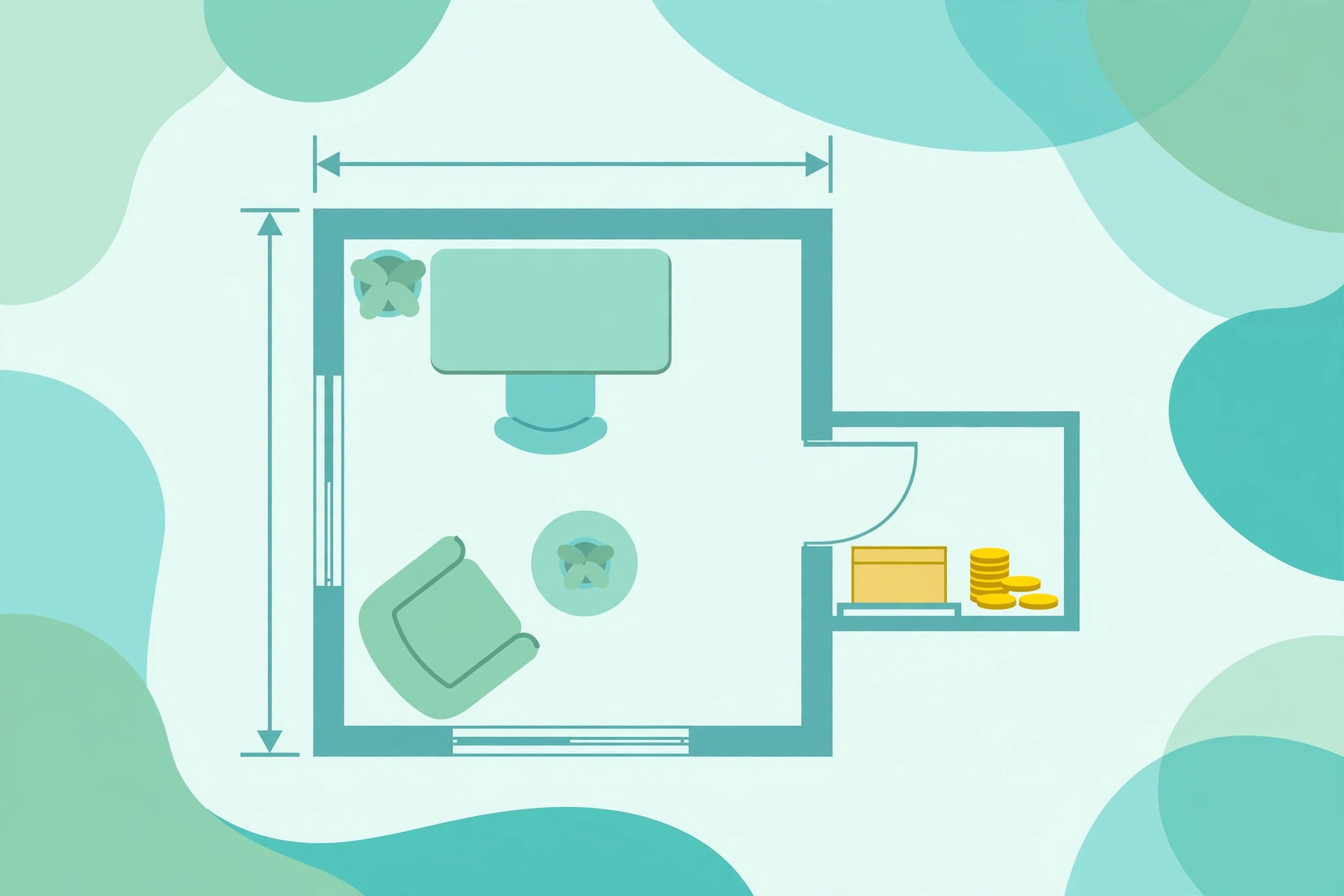
Whichever you choose, measure honestly and photograph the space. In an audit, a dated photo of a clearly exclusive office and a simple floor-plan sketch with dimensions ends most questions. The taxpayers who lose home-office audits lose on exclusive use, not on math.
One more planning note: the home-office deduction can't create a loss beyond your business income (excess carries forward), and it also reduces your self-employment tax base — a double benefit most people miss. Size the full picture with the US Self-Employment (SECA) Tax & Schedule SE Calculator to see how the deduction flows through both income tax and SE tax.
Recordkeeping: the 15-minute system
The actual method's reputation for paperwork is worse than the reality — if you set up the system once. Here's the minimal version that survives audits:
One folder, four document types. Create a tax-year folder (physical or digital) holding: (1) a dimensioned sketch or floor plan with the office area shaded and measured; (2) a dated photo of the office showing exclusive business use; (3) monthly utility bills and insurance statements; (4) receipts for direct office expenses and whole-home repairs. That's it. No spreadsheet artistry required — the allocation math (office sq ft ÷ total sq ft) fits on an index card.
The 15-minute monthly habit. When each utility bill arrives, drop it in the folder and jot the amount on a running list. Twelve entries a year. At tax time, sum the list, multiply by your business-use percentage, and you're done. People who do this monthly spend maybe three hours a year on home-office records; people who reconstruct it in April spend a weekend and miss half the receipts.
What to keep and how long. Keep everything at least 3 years after filing (the standard audit window), 6 if you underreported significantly, and property records including depreciation schedules for as long as you own the home plus 3 years. Digital copies are fully acceptable — photograph paper receipts before the thermal ink fades, because it will.
The simplified method's records. Even simplified filers should keep the measurement sketch and one photo. The method needs no expense receipts, but exclusive use still has to be true — and provable if asked.
Try it free — no sign-up
Run the numbers yourself in seconds. Everything happens in your browser.
Open the US Self-Employment (SECA) Tax & Schedule SE CalculatorFrequently Asked Questions
Can W-2 employees claim the home office deduction?
No. The deduction for unreimbursed employee expenses — including home offices — was suspended for tax years 2018–2025 and remains unavailable to employees. Only self-employed individuals, freelancers, and business owners can claim it. Remote employees should ask their employer about tax-free reimbursements under an accountable plan instead.
What is the simplified home office deduction for 2026?
$5 per square foot of exclusive business-use space, up to 300 square feet, for a maximum $1,650 deduction. No receipts or expense tracking required — just the measurement. You can't combine it with actual expenses for the same space.
What does "exclusive use" mean for the home office deduction?
The space must be used only for business — a spare bedroom that's 100% office qualifies; a living-room corner used for work and family TV time doesn't. Exceptions exist for inventory storage and licensed daycare. It's the strictest test and the most common audit failure point.
Is the home office deduction worth it?
For the self-employed with a genuine exclusive office, usually yes. The simplified method saves ~$110–$360 in tax for 10 minutes of work (at 12–22% rates on up to $1,650). The actual method can save $500–$1,500+ for homeowners and renters with real housing costs. For W-2 employees, it's worth nothing — they're ineligible.
Does claiming the home office deduction increase audit risk?
It's a known audit flag, but legitimate claims with documentation sail through. The red flags are round-number square footage, offices that are implausibly large relative to the home, and failing exclusive use. Keep a photo of the space, a dimensioned sketch, and your expense records.
What happens to depreciation when I sell my home?
Depreciation claimed on the business portion is subject to recapture tax (up to 25%) when you sell — it reduces your basis and the home-sale exclusion doesn't shelter the recaptured amount. This is why many advisors suggest skipping the depreciation component of the actual method. The simplified method involves no depreciation and no recapture.